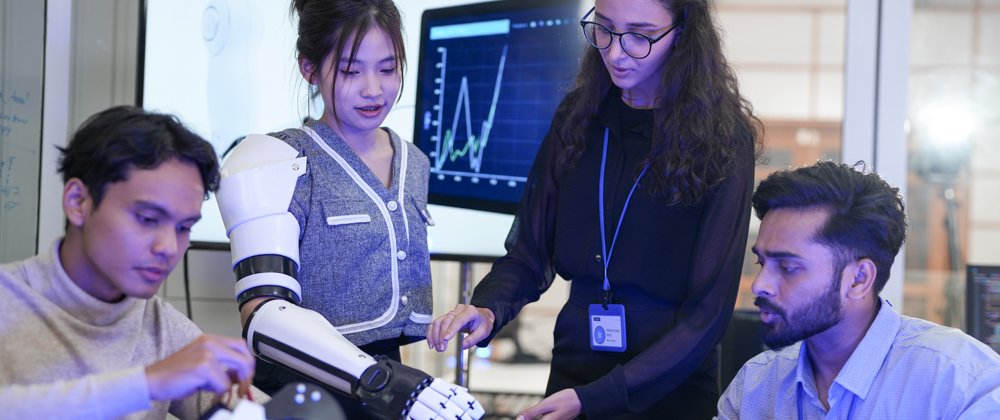
Biomedical Engineering applies core engineering disciplines — mechanical, electrical, and materials science — directly to medicine: designing prosthetics, medical imaging equipment, implants, diagnostic devices, and the instrumentation hospitals rely on daily. It's a genuinely interdisciplinary degree, and a small number of countries have built outsized reputations specifically in this field, tied to their medical-device manufacturing industries.
Ireland stands out in particular: 15 of the top 20 global medical device companies operate there, Ireland is the second-largest medical device exporter in Europe, and remarkably, 80% of the world's coronary stents are manufactured in Galway alone — the same city that hosts Ireland's only direct-entry Biomedical Engineering degree.
A naming note worth knowing upfront: this degree is typically called BEng (Bachelor of Engineering) in the UK, Ireland, Canada, Australia, and Singapore, but in the US it's almost always a BS/BSc (Bachelor of Science) — same field, different naming convention.
Key Highlights
- Standard duration is 3 years in the UK (4 with placement), 4 years in Canada, Australia, Singapore, and the US, 3–3.5 years in Germany, and 3 years (180 ECTS) in Albania.
- Ireland runs an integrated 4+1 structure: a 4-year BE (Level 8) meets Associate Engineer status alone, while the additional 1-year ME (Level 9) is required for full Chartered Engineer status — University of Galway's programme is Ireland's only direct-entry route into this specific field.
- Germany's Bachelor's-level programmes remain primarily German-taught, unlike its Master's-level offerings in the same field, which are far more commonly available in English.
- Albania's WBU programme is fully English-taught with a capstone thesis often done in collaboration with industry partners.
- Professional engineering licensure is less standardised for this specific field than for Civil, Mechanical, or Electrical Engineering — in the US particularly, many biomedical engineers license via a related discipline's exam instead of a dedicated biomedical pathway.\
How Structure and Accreditation Vary by Country
| Country | Degree Name & Duration | Accreditation / Recognition | Notes |
| Ireland | Integrated BE (4 yrs, Level 8) + ME (1 yr, Level 9) | Engineers Ireland; Washington Accord recognised | Ireland's only direct-entry programme (University of Galway); based in Europe's leading medtech manufacturing hub |
| United Kingdom | BEng (Hons), 3 years (4 with placement); 4-year MEng also available | IET and/or IMechE, on behalf of the Engineering Council | BEng typically partially meets CEng; MEng meets CEng directly |
| Australia | Bachelor of Engineering (Honours), 4 years | Engineers Australia; Washington Accord recognised | Offered at multiple universities (Sydney, UTS, UNSW, Flinders, UWA, QUT) |
| Canada | BEng, 4 years | CEAB (Canadian Engineering Accreditation Board) | Standard route toward provincial P.Eng licensure |
| Singapore | BEng, 4 years | Institution of Engineers Singapore (IES) framework | Washington Accord–aligned recognition |
| United States | BS/BSc (not BEng), 4 years | ABET, Engineering Accreditation Commission | No uniformly standardised "biomedical" PE license |
| Germany | Bachelor's, 3–3.5 years | ASIIN | Primarily German-taught at Bachelor's level; low/no tuition at public universities |
| Albania (e.g., Western Balkans University) | Bachelor's, 3 years, 180 ECTS | WBU, accredited by ASCAL | Fully English-taught; lower-cost, emerging destination |
This table reflects general national frameworks — always confirm the specific university's accreditation, structure, and language of instruction before enrolling.
What Will You Study?
- Human Anatomy and Physiology for Engineers
- Biomechanics and Biomaterials
- Medical Imaging and Instrumentation
- Biomedical Signal Processing
- Prosthesis and Implant Design
- Medical Device Regulation and Ethics
- A capstone design project or thesis, often with direct industry or clinical collaboration
Where Can This Degree Take You?
Medical Device Design and Development – prosthetics, implants, diagnostic and monitoring equipment; particularly strong career entry point in Ireland's medtech cluster
Clinical Engineering – working within hospitals to maintain and improve medical technology
Medical Imaging Technology – developing and improving imaging systems (distinct from operating them, which is the Radiography path)
Regulatory Affairs – ensuring medical devices meet safety and compliance standards
Research and Academia – biomedical research, often progressing to postgraduate study
Healthcare Technology Industry – roles at medical device and health-tech companies globally, with Ireland and Germany offering particularly strong local industry access
Is This Course Right for You?
This course may be a good fit if you:
- Are strong in Physics and Mathematics but also genuinely interested in biology/medicine.
- Want direct proximity to the global medical device industry during your studies — Ireland in particular offers this in a way few other countries can match.
- Are open to a German-medium Bachelor's if targeting Germany specifically, or prefer an English-taught route (Ireland, UK, Canada, Australia, Singapore, US, or Albania).
Worth thinking through before you commit:
- If considering Germany, confirm the language of instruction for your specific shortlisted programme early.
- If formal Professional Engineer licensure matters long-term, research your target country's specific pathway, since it's less standardised here than in other engineering branches.
Why It Matters for Kerala Students
Biomedical Engineering bridges the engineering and health-sciences clusters we've built out separately on this site, and gives Kerala's strong engineering-graduate pipeline a genuine option within global healthcare technology. Ireland's position as a world-leading medtech manufacturing hub makes it a particularly compelling destination — genuine industry proximity during study is rare in most fields, and this is one where it's a defining feature rather than a marketing point.
Frequently Asked Questions
Is this called BEng everywhere?
No — it's BEng in the UK, Ireland, Canada, Australia, and Singapore, typically BS/BSc in the US, and simply "Bachelor's" in Germany and Albania under their own systems.
Why is Ireland highlighted so strongly for this course?
Ireland has an outsized global role in medical device manufacturing — 15 of the top 20 global medtech companies operate there, and Galway alone produces roughly 80% of the world's coronary stents. University of Galway's integrated BE+ME is Ireland's only direct-entry programme in this specific field.
Do I need to know German to study this in Germany?
Likely yes, at Bachelor's level specifically — Master's-level programmes are far more commonly available in English.
Can I become a licensed Professional Engineer with this degree?
It depends on the country, and this field doesn't have as standardised a licensing path as Civil or Mechanical Engineering.
Is this the same as Biomedical Science?
No — Biomedical Science is a science degree focused on diagnostics and lab work; Biomedical Engineering is an engineering degree focused on designing medical devices and technology.
Start Your Study Abroad Journey
Considering a career bridging engineering and healthcare? Our counsellors can help you compare degree structures, industry access, and costs across countries — including Ireland's medtech hub — to find the right fit for your goals.
📞 +91 96561 21000
📍 IRS Study Abroad, 3rd Floor, Vettiyil Endow, Opp Pvt Bus Stand, Nagampadom, Kottayam
🌐 Start Your Study Abroad Journey: https://join.irsstudyabroad.com/