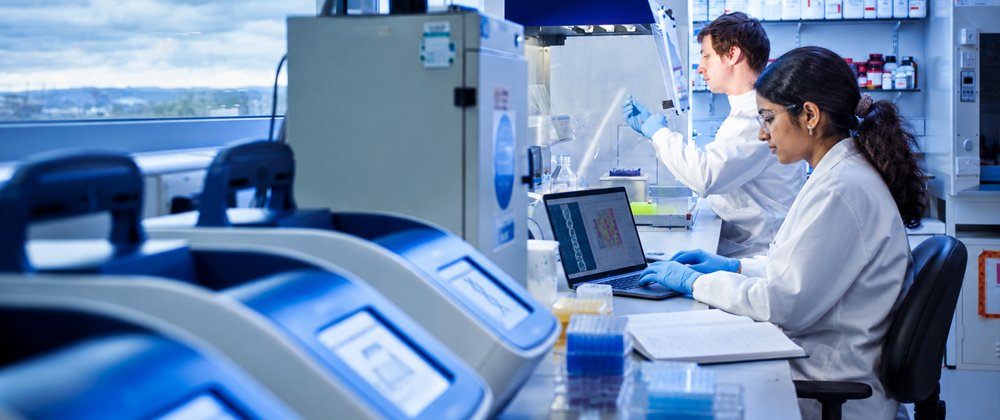
Modern biology produces more data than people can read by eye: genomes, protein structures, and the results of thousands of lab experiments. Bioinformatics combines biology with programming, statistics, and machine learning to make sense of that data. It sits between life sciences and computing, and a Master’s in this field is one of the few routes where a biology graduate can move into data-driven work without starting a second Bachelor’s.
A naming note worth knowing: the same field appears as Bioinformatics, Computational Biology, Bioinformatics and Computational Biology, Bioinformatics and Systems Biology, and in some places bio-focused Data Science. The balance between biology and computing differs by title, so read the module list before assuming what you’d be studying. IRS Study Abroad in Kottayam also separates it from MSc Biotechnology (mainly wet-lab) and MSc Data Analytics (mainly business applications), which are different courses.
Key Highlights
- Many programmes are built for biology graduates. Some UK programmes are aimed at students from biology, biochemistry, genetics, medicine, and related sciences, and at least one is explicitly not aimed at computer science graduates. This is what makes the degree valuable for life-science students who can’t easily enter a computer science Master’s.
- Some programmes accept several backgrounds. Ireland’s University College Cork runs a one-year MSc with separate streams for biology, computer science, maths, and statistics graduates.
- Duration depends on the country. It’s 1 year in the UK and Ireland, 2 years in Germany and the Netherlands, and flexible in Australia, where the length depends on your prior qualification. Canadian programmes are thesis-based.
- Entry requirements vary a lot. Some programmes need a 2:1 equivalent in a relevant science, and Canada’s Guelph asks for a four-year degree with at least a 75% average over the last two years. Check whether your degree length qualifies before you apply.
- Programming and statistics are central. Expect to learn coding, data analysis, and machine learning alongside genomics and molecular biology, whatever your background.
How Structure Varies by Country
| Country | Typical Programme & Duration | Entry & Structure | Notes |
|---|---|---|---|
| United Kingdom | MSc Bioinformatics, 1 year | Usually a relevant life-science degree; taught modules plus a research project | Offered by universities including Bristol, Nottingham, Leicester, and Liverpool; some are designed for biology graduates, not computer scientists |
| Ireland | MSc Bioinformatics & Computational Biology, 1 year (University College Cork) | Four streams for biology, computer science, maths, or statistics graduates | Graduates have gone on to work with Teagasc, technology multinationals, and biopharma |
| Germany | Master’s programmes, typically 2 years | Many are English-taught (Freie Universität Berlin, Tübingen, Heidelberg, Bonn, and others) | Language and tuition vary by university and programme; at Tübingen, the fully English variant is for those with a bioinformatics Bachelor’s |
| Netherlands | MSc Bioinformatics, 2 years | Offered at Leiden, Amsterdam (Bioinformatics and Systems Biology), and Wageningen | Non-EU tuition is much higher than in Germany |
| Australia | Master of Bioinformatics (University of Queensland and others), duration depends on prior study | Entry from science, IT, or engineering degrees, with a graduate certificate or diploma route | International students can apply for a student visa; you may be considered for a longer version if you don’t meet requirements for the shortest |
| Canada | MSc Bioinformatics (University of Guelph), thesis-based | Four-year degree, 75% average, and a faculty supervisor must agree before an offer | Research-led, with a very different structure from UK and Irish taught courses |
| United States | MS Bioinformatics or Computational Biology (for example Johns Hopkins) | Varies by programme | Some programmes are described as STEM-designated, which can matter for post-study work; confirm for each programme |
Bioinformatics programmes also appear in listings for France, Italy, Portugal, Malta, Lithuania, and Poland, but we haven’t detailed them here. Always confirm each university’s duration, entry requirements, and language of instruction with your counsellor at IRS Study Abroad.
What Will You Study?
- Genomics and Sequence Analysis
- Programming for the Life Sciences (usually Python and R)
- Statistics and Machine Learning for Biological Data
- Protein Structure and Computational Biology
- Databases and Data Management
- A supervised research project or dissertation
Where Can This Degree Take You?
Bioinformatics Scientist and Computational Biologist – developing and applying tools to analyse biological data
Pharma and Biotech – drug discovery, genomics, and clinical data analysis
Genomics and Healthcare Data – roles linked to precision medicine and clinical bioinformatics
Data Science and Software Roles – applying data skills to life-science and general data work
Research Institutes and Universities – analyst and research roles, often a route to a PhD
Agriculture and Environmental Science – analysing genomic and biodiversity data
Is This Course Right for You?
This course may be a good fit if you:
- Have a biology, biotechnology, or life-science background and want to add computing and data skills.
- Are ready to learn programming and statistics from the start, or already have some experience.
- Want a research-oriented path that can lead to industry or a PhD.
Why It Matters for Kerala Students
Kerala produces many biology, biotechnology, and life-science graduates, and this degree is one of the few ways to combine that background with computing. The counsellors at IRS Study Abroad in Kottayam see students who want to move beyond a traditional lab career but aren’t sure how. Bioinformatics is also available in India, including at Central University of Kerala, so a student considering it abroad should have a clear reason, such as the one-year formats in the UK and Ireland, Germany’s research institutes, or access to a specific research group.
Frequently Asked Questions
Do I need a computer science background to apply?
Not usually. Many programmes, especially in the UK, are designed for biology graduates, and some Irish programmes have streams for different backgrounds. Expect to learn programming and statistics during the degree.
What’s the difference between Bioinformatics and Biotechnology?
Biotechnology is mostly lab-based and focuses on applying biology to products and processes. Bioinformatics is mostly computational, analysing biological data with software and statistics. See our MSc Biotechnology page.
What’s the difference between Bioinformatics and Data Analytics?
Data Analytics generally focuses on business and general data applications. Bioinformatics applies data skills specifically to biological and medical data and expects some biology background.
Is my three-year Bachelor’s degree accepted?
It depends on the programme. Some universities accept it, while others, such as Canada’s Guelph, ask for a four-year degree. Check each programme’s requirements.
Which country is best?
It depends on your goals. The UK and Ireland offer one-year taught courses, Germany and the Netherlands offer two-year research-heavy options, Australia offers flexible entry routes, and Canada is thesis-based.
Start Your Study Abroad Journey
Considering a career where biology meets data? The counsellors at IRS Study Abroad in Kottayam can help you compare programmes across the UK, Ireland, Germany, the Netherlands, Australia, Canada, and the US, and match the course to your background.
📞 +91 96561 21000
📍 IRS Study Abroad, 3rd Floor, Vettiyil Endow, Opp Pvt Bus Stand, Nagampadom, Kottayam
🌐 Start Your Study Abroad Journey: https://join.irsstudyabroad.com/