
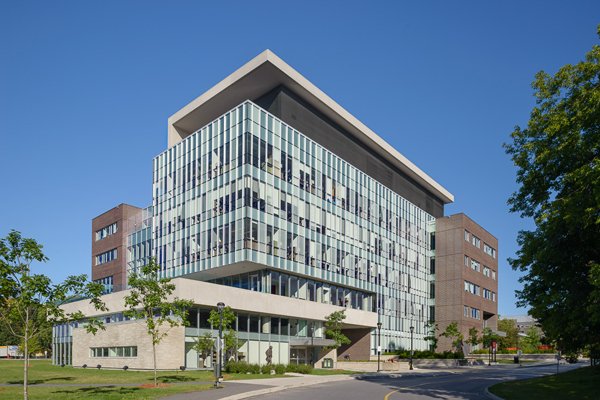
Carleton University was founded in 1942 as Carleton College, a non-denominational evening college created specifically to support returning World War II veterans—a distinctive origin story that reflects the university's practical, access-oriented roots from the outset. It gained full university status in 1952 and today sits on a campus bordered by the Rideau River and the Rideau Canal, a UNESCO World Heritage Site, close to Canada's Parliament Buildings and the Byward Market. That location gives our Canada portfolio a clear contrast with the University of Ottawa's bilingual, government-adjacent identity: both universities sit in the capital, but Carleton has built its reputation around journalism, public affairs, and international relations.
More than 30,000 students study here, drawn from over 150–160 countries, across six faculties and more than 65 degree programmes.
Why Carleton Stands Out
Carleton's Journalism programme places students directly in Canada's major media hub, with national media outlets and some of the country's leading journalists based in Ottawa itself, regularly offering internships and career opportunities to Carleton students. Students train in state-of-the-art digital newsrooms and broadcast studios, and can take part in the Global Journalism International Internship programme, run in partnership with Farm Radio International — a specific, structured overseas placement opportunity within the journalism degree itself.
A few specifics worth knowing:
- Over 200 programmes offer co-op and paid work placements lasting four to sixteen months, alternating with academic terms — a substantial, structured work-integrated learning model
- Located in a G7 capital city with access to government institutions, global organisations, and a technology sector of more than 1,800 companies
- Notable alumni include Lester B. Pearson, winner of the Nobel Peace Prize, alongside physicist and author Lawrence M. Krauss
- A founding member of the Council of Ontario Universities and a charter member of the Association of Universities and Colleges of Canada
- More than 875 academic staff members are internationally recognised for scholarly work across over 50 fields, with particular strength in journalism, public affairs, international affairs, architecture, and technology
Popular Courses
Carleton's academic identity centres on a specific cluster of fields tied directly to its location and history:
- Journalism — Carleton's clearest area of distinct national reputation, backed by real newsroom-style facilities and industry placement pathways
- Public Affairs and Public Policy
- International Relations and International Affairs
- Architecture — one of Carleton's other consistently well-regarded programmes
- Engineering and Computer Science — through one of the country's larger engineering faculties
- Business, Data, and Communication
Career Opportunities & Student Value
Carleton's location gives students direct, practical proximity to the institutions many of its programmes are built around — government departments, NGOs, and multinational organisations for public affairs and international relations students, and Canada's national media outlets for journalism students. The co-op structure spanning over 200 programmes means students in many fields graduate with real, paid work experience already built into their degree, not arranged separately as an afterthought.
Carleton also distributed more than $23 million in scholarships and bursaries to undergraduate students in a recent year, a specific figure worth knowing for students weighing the total cost of study.
Why Students from Kerala Are Looking at Carleton
For Kerala students specifically interested in Journalism, Public Affairs, or International Relations, Carleton offers a distinct pathway among our Canada listings: real, structured co-op work experience, direct proximity to Ottawa's government and media institutions, and a journalism programme with genuine industry-facing infrastructure rather than a general communications degree. Its practical, evening-college origins have carried through into a university still built around accessible, career-focused education.
Students should approach Carleton with a clear sense that its strength lies in specific fields rather than a single, dominant overall prestige ranking — a fit worth choosing based on subject match rather than a headline number alone.
Is Carleton Right for You?
Carleton could be a strong fit if:
- you're specifically interested in Journalism, Public Affairs, or International Relations, and want direct access to Ottawa's government and media institutions
- you'd value a structured co-op programme with paid work placements built into your degree
- you're drawn to studying beside a UNESCO World Heritage site, within Canada's capital city
- you're interested in Architecture or Engineering, both areas of consistent institutional strength
- you're choosing based on Carleton's specific subject reputation rather than its overall global ranking position
Interested in Studying at Carleton University?
IRS Study Abroad provides personalised guidance on university selection, applications, documentation, visa processing, scholarships, and pre-departure support
📞 +91 96561 21000
📍 IRS Study Abroad, 3rd Floor, Vettiyil Endow, Opp. Pvt Bus Stand, Nagampadom, Kottayam
🌐 Start Your Study Abroad Journey: https://join.irsstudyabroad.com/