
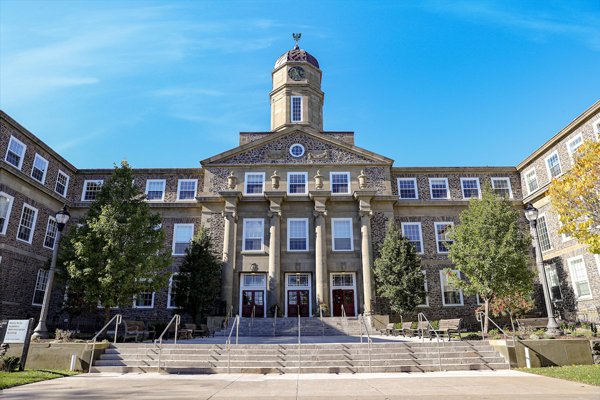
Dalhousie University was founded in 1818 by George Ramsay, the ninth Earl of Dalhousie, who served as Lieutenant-Governor of Nova Scotia and modelled his new college directly on the University of Edinburgh — funding its construction with his own money, with the explicit aim of building a higher education institution genuinely open to all. The university began formally awarding degrees in 1866, and today teaches over 19,000–21,000 students across 13 faculties on Canada's East Coast — a research university profile genuinely distinct from our other Atlantic Canada listing, Mount Saint Vincent, which is a smaller, teaching-focused institution.
Dalhousie's main campuses sit in Halifax, Nova Scotia — the economic, educational, and cultural hub of Atlantic Canada, and home to six universities and one of the country's largest student communities — with an additional Agricultural Campus in nearby Truro.
Why Dalhousie Stands Out
Dalhousie's Oceanography programme is ranked 37th in the world, and 2nd among all Canadian universities, in the 2025 Global Ranking of Academic Subjects — a genuinely rare, specific subject distinction reflecting Halifax's coastal location and Dalhousie's long-standing marine and ocean sciences research strength. This isn't a broad institutional claim; it's a measured, subject-specific global ranking.
A few more specifics that set Dalhousie apart:
- Dalhousie's alumni network includes 95 Rhodes Scholars, alongside Canadian prime ministers, premiers, a Nobel Prize winner, Olympic medallists, and space pioneers — spanning more than 160,000 alumni across 150+ countries
- Ranked in Canada's top 14 by Times Higher Education and 12th overall in Canada by QS World University Rankings 2026
- 20 subjects appear in the 2025 Global Ranking of Academic Subjects, including strong positions in Atmospheric Science, Environmental Science & Engineering, Law, Public Health, and Earth Sciences — genuine breadth across sciences, medicine, and social sciences
- Nearly 90% of Dalhousie students take part in experiential, work-integrated learning — co-ops, practicums, field courses, or international exchanges — as a standard part of their degree, not an optional add-on
- Holds a Gold rating in the Sustainability Tracking, Assessment & Rating System (STARS), reflecting genuine institutional commitment to sustainability practice, not just messaging
Popular Courses
Dalhousie offers more than 200 degree programmes and over 4,000 individual course options across its 13 faculties:
• Oceanography and Earth & Marine Sciences — Dalhousie's strongest globally-ranked subject area, drawing directly on Halifax's coastal research environment
• Medicine, Health Sciences, and Public Health — genuine research strength, including one of Canada's respected medical faculties
• Law — ranked among Dalhousie's top globally recognised subjects
• Computer Science and Engineering — including strong standing in Environmental Engineering specifically
• Management, Arts and Social Sciences, Agriculture — offered through the Rowe School of Business and the Truro Agricultural Campus
Career Opportunities & Student Value
Halifax itself is a genuine centre for innovation in ocean technology, healthcare, life sciences, financial services, defence, and clean technology — giving Dalhousie students direct access to co-op placements, internships, and industry research connections tied to the city's actual economic strengths, not a generic "strong career services" claim. The Bissett Student Success Centre runs dedicated career advising, résumé and interview support, and on-campus recruitment specifically for Dalhousie students.
With almost 90% of students completing some form of experiential or work-integrated learning during their degree, Dalhousie graduates typically leave with documented practical experience directly relevant to their field, reinforced by a large, genuinely global alumni network across 150+ countries.
Why Students from Kerala Are Looking at Dalhousie
For Kerala students who want a genuine, research-intensive Canadian university on the East Coast — rather than the more commonly chosen Toronto or Vancouver — Dalhousie offers real academic depth (top-14 Canada research standing) combined with Halifax's specific strengths in oceanography, marine sciences, and healthcare. Students weighing Atlantic Canada specifically will find Dalhousie a meaningfully stronger academic and research profile than a smaller teaching college, while Halifax itself offers a lower cost of living than Toronto or Vancouver, alongside a well-established, welcoming student city atmosphere.
Students specifically interested in ocean sciences, environmental engineering, or public health have a genuine reason to consider Dalhousie over our larger-city Canadian listings, given its specific globally-ranked strength in these fields.
Is Dalhousie Right for You?
Dalhousie could be a strong fit if:
- you're specifically interested in Oceanography, Earth & Marine Sciences, or Environmental Engineering, and want access to globally top-ranked research in these fields
- you want a genuine research-intensive university experience on Canada's East Coast, rather than Toronto or Vancouver
- you'd value a university with a large, documented history of producing Rhodes Scholars and other globally recognised alumni
- structured, work-integrated learning (co-ops, practicums, exchanges) matters to you as a standard part of your degree
- affordability relative to Toronto or Vancouver's cost of living is a genuine factor in your decision
Interested in Studying at Dalhousie University?
IRS Study Abroad provides personalised guidance on university selection, applications, documentation, visa processing, scholarships, and pre-departure support.
📞 +91 96561 21000
📍 IRS Study Abroad, 3rd Floor, Vettiyil Endow, Opp Pvt Bus Stand, Nagampadom, Kottayam
🌐 Start Your Study Abroad Journey: https://join.irsstudyabroad.com/