
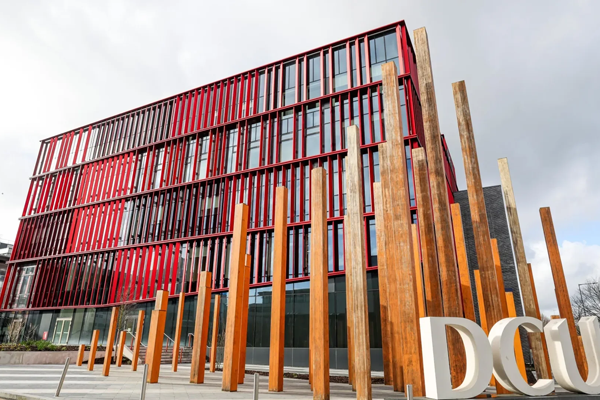
Dublin City University (DCU) began life in 1975 as the National Institute for Higher Education, opened its doors to students in 1980, and was elevated to full university status by Irish statute in 1989 — making it one of Ireland's youngest universities by name, but with a genuinely distinct identity built over five decades. DCU describes itself as Ireland's "University of Enterprise," and that isn't just a slogan: it was the first university in Ireland to build paid workplace internships, known as INTRA, directly into its undergraduate degrees, at a time when work placements were rare in Irish higher education. More than 80% of DCU's programmes still include this kind of work-based learning today.
The university sits across three campuses in the Glasnevin-Drumcondra area of north Dublin, home to just over 20,000 students, including an international cohort drawn from more than 120 countries, taught across five faculties: DCU Business School, Engineering and Computing, Science and Health, Humanities and Social Sciences, and the DCU Institute of Education.
Why DCU Stands Out
DCU Business School holds Triple Crown accreditation — AACSB, EQUIS, and AMBA — a combination held by only around 1% of business schools globally. That places DCU's business programmes in genuinely elite company on accreditation alone, distinct from a general "strong business school" claim.
A few more specifics that set DCU apart:
- Pioneered INTRA, Ireland's first integrated workplace internship model for undergraduates, now embedded in over 80% of its degree programmes
- Ranked #1 in Ireland for Research Quality in the Times Higher Education World University Rankings 2026
- Postgraduate "Practicum" projects let Master's students work on real, live problems for partner companies rather than case studies alone — running alongside placement partnerships with organisations including Microsoft, Mastercard, and Accenture
- DCU's journalism programmes carry NUJ (National Union of Journalists) accreditation, a specific professional-body recognition not standard across Irish journalism degrees
- Sunday Times University of the Year (2010) — a distinction awarded for overall institutional performance, not a single subject area
Popular Courses
DCU's five faculties give it real breadth, but its strongest identity is where enterprise and academic study intersect:
- DCU Business School — global business, accounting, finance, marketing, human resources, and two newly launched MSc programmes in Quantitative Economics for Business and International Business (2026 intake)
- Engineering and Computing — computing, data analytics, electronic engineering, mechanical manufacturing
- Science and Health — biotechnology, chemical sciences, nursing, psychology, human sciences
- Humanities and Social Sciences — communications and journalism (NUJ-accredited), law, languages, history
- DCU Institute of Education — arts education, inclusive and special education, early childhood education
Applicants without qualifications that meet direct-entry requirements can apply through DCU's International Academy foundation pathway. Undergraduate applicants typically need an IELTS score of 6.5 overall (no band below 6.0); postgraduate applicants generally need the same, with DCU Business School and the School of Communications requiring at least 6.5 specifically in writing and speaking.
Career Opportunities & Student Value
DCU's own data points to graduate employment rates in the low-to-mid 90s within six months of graduation, and the university is frequently cited as outperforming its general global league-table position on real-world employability — a gap that reflects how deliberately its degrees are built around industry contact rather than academic study alone. Beyond INTRA placements, DCU's five faculties run active research and enterprise hubs, giving postgraduate students direct pathways into applied research partnerships alongside their coursework.
Graduates in Ireland on a Level 9 Master's degree from DCU are eligible for the Stamp 1G post-study work permission, giving up to 24 months to find employment after graduating — a meaningful window for international students weighing their long-term plans.
Why Students from Kerala Are Looking at DCU
For Kerala students comparing Dublin's universities, DCU's real differentiator is structural rather than reputational: a degree here is built to include paid work experience as standard, not something students have to source and arrange for themselves. That matters directly for the return on a family's investment in an Irish degree — graduating with INTRA placement experience and, where relevant, a Triple Crown-accredited business qualification gives a practical edge that a purely classroom-based degree elsewhere may not.
DCU's north Dublin campuses also place students close to the city's employment base while sitting apart from Dublin's most expensive central rental market, a detail worth weighing for students budgeting total cost of study rather than tuition alone.
Is DCU Right for You?
DCU could be a strong fit if:
- you want a degree that includes structured, paid work experience by default, not as something you have to organise separately
- you're specifically interested in a Triple Crown-accredited business education, or in journalism with professional NUJ accreditation
- research quality matters to you, and you'd value studying at Ireland's #1-ranked university for research quality (THE 2026)
- you're comfortable prioritising a university's practical outcomes and industry links over chasing the highest global league-table position
- you want the full 24-month Stamp 1G post-study work window that comes with a Level 9 Master's
Interested in Studying at DCU?
IRS Study Abroad provides personalised guidance on university selection, applications, documentation, visa processing, scholarships, and pre-departure support
📞 +91 96561 21000
📍 IRS Study Abroad, 3rd Floor, Vettiyil Endow, Opp Pvt Bus Stand, Nagampadom, Kottayam
🌐 Start Your Study Abroad Journey: https://join.irsstudyabroad.com/